
A free-kick is how you restart play after a foul, but ask any player and it is a lot more than that. It is a moment of high drama and, from the right spot, one of the few times in a match where an attacker gets a clean, unhurried strike at goal. I spent enough years lining up in walls to know both sides of it: the takers who terrified you and the ones you happily let shoot.
The distance from goal, the angle, and the taker's own habits all feed into how a free-kick plays out. That is what makes each one its own little contest inside the game.
Key Takeaways
| Aspect | Details |
|---|---|
| Definition | A method to restart play following a foul or infringement |
| General Rules | Awarded for fouls, taken from the spot of the infringement, opponents at least 9.15 meters (10 yards) away |
| Causes | Fouls, handballs and other rule violations |
| Types | Direct (can score directly) and Indirect (requires touch by another player) |
| Positioning | Key for attackers and defenders |
| The Wall | A defensive strategy to block the taker's view and shot |
What is a Free kick?
A free kick is awarded when a team is fouled by the opposing side. It is a chance for the fouled team to reset and, ideally, gain an advantage. From an attacker's point of view it is a rare free look at goal or a set play you have rehearsed on the training ground, and from a defender's it is a scramble to get organised before the whistle.
Play stays stopped until the referee signals the free kick, so both teams are set and following the rules before the ball moves. That pause is longer than people realise, and how a team uses it, getting the wall right or picking out a runner, often decides what happens next.
Types of Free kicks
The team awarded the kick has a choice, and it usually comes down to the location of the foul, the team's style, and who is standing over the ball.

direct free kick
They can go straight for goal, trying to beat the wall and the goalkeeper in one strike.
Direct Free Kick Signal
For a direct free kick, the referee blows the whistle and extends an arm horizontally. As players, we read that arm instantly: it means a shot on goal is on.
indirect free-kick
Otherwise the team passes to a teammate first. This can pull the defensive shape apart, open a better shooting angle, or just keep possession in a stronger spot.
Indirect Free Kick Signal
For an indirect free kick, the referee blows the whistle and holds an arm vertically above the head, and keeps it there until a second player touches the ball. That raised arm is your cue that nobody can score directly.
General Free Kick Rules
When a foul is given, play stops, and the basic routine for restarting is the same whatever type of free kick is awarded.
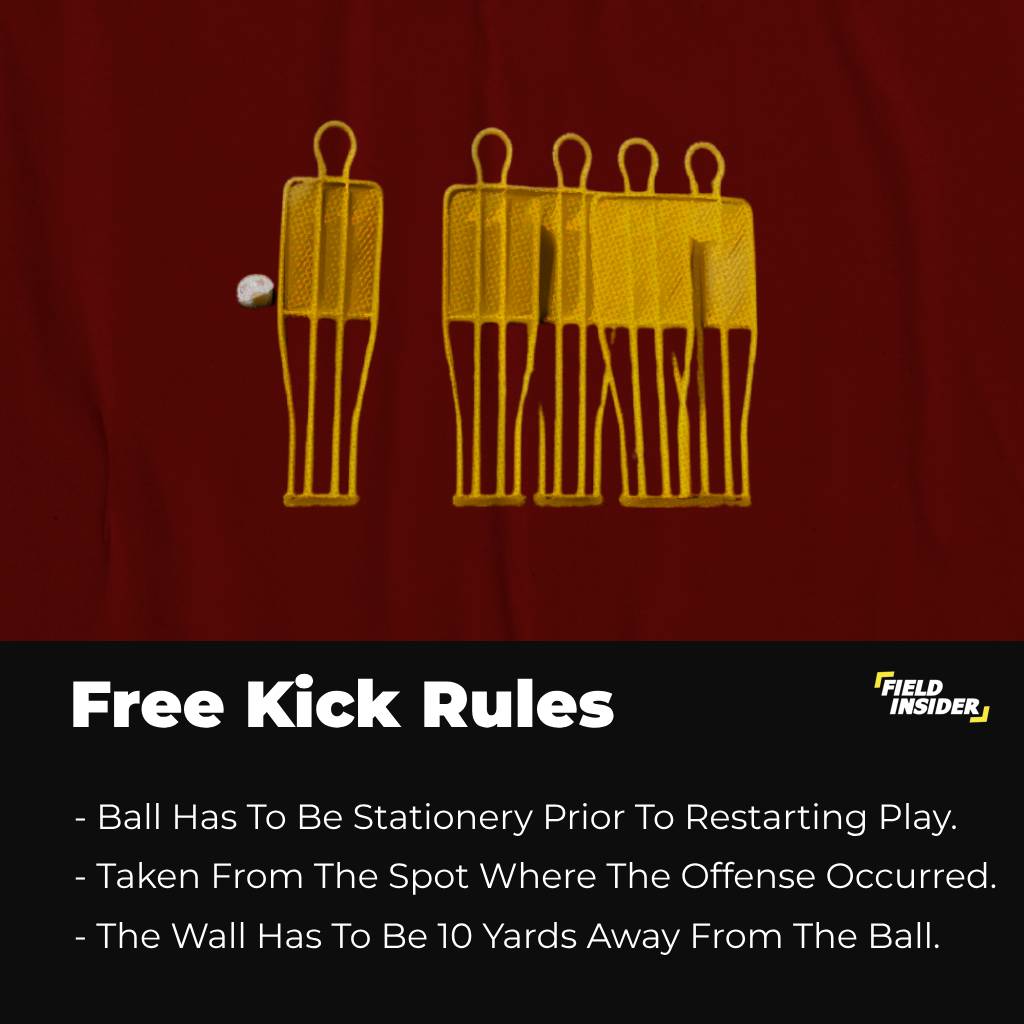
The Rules
All free kicks follow Law 13 of the laws of the game.
- The ball must be dead still before the kick is taken.
- The ball is in play only once someone touches and moves it.
- The taker may touch the ball only once.
- The kick is taken from the exact spot of the offence. If the foul happens off the pitch, play restarts from the nearest point on the line.
- If the foul is inside the team's own goal area, they may place the ball anywhere within that area.
- Defenders must stand or form a wall ten yards away from the spot.
Causes of Free Kick
Direct or Indirect?
When a team commits an offence, the opponent gets a free kick. Whether it is direct or indirect comes down to the kind of offence. The referee reads the foul and decides.
Causes of a direct free kick
Certain infractions hand the opposition a direct free kick. These include:
Use of unnecessary extra force
Most free kicks come from a player being careless or reckless. If the referee judges that a player used excessive force while doing any of the following, it is a direct free kick:
- Pushing or jumping at an opponent.
- Kicking or striking at an opponent.
- Holding an opponent.
- Tripping or trying to trip an opponent.
COMMITTING A HANDBALL
The goalkeeper is the only player allowed to handle the ball, and only inside their own penalty area. Any other handball gives the opposing team a direct free kick.
IMPRUDENT BEHAVIOR
Rash or offensive behaviour also concedes a free kick. Such actions include:
- Spitting at an opponent.
- A physical offence against an opponent.
- Throwing an object or the ball at an opponent or the referee.
This kind of thing often brings a yellow or red card as well.
ENTERING THE PITCH OR INVADING THE PLAY
Nobody enters the pitch or interferes with play without the official's consent. If a substitute or team official comes on without permission, the opposing team gets a free kick.
Causes of an Indirect Free Kick
Indirect free kicks are less common, because the offences behind them happen less often. The usual ones are:
- A player caught offside. This is by far the most common cause.
- Illegal handling of the ball by the goalkeeper.
- Impeding an opponent without any physical contact.
- Dissent between a player and an official, or between players.
- Kicking or trying to kick the ball while the goalkeeper is releasing it.
- Trying to impede the goalkeeper as he releases the ball.
- Playing in a dangerous way without a foul being committed.
- Making offensive gestures or being abusive.
- Entering the pitch without the referee's consent but not interfering with play.
- Distracting or obstructing a player taking a throw-in.
A few more relate to penalties, such as the penalty failing to go forward, or an illegal feint by the taker to fool the goalkeeper.
The Art of Taking a Free-Kick
A good free-kick is talent, endless practice, and an almost scientific feel for how the ball moves through the air. The players who scared me were not always the ones who hit it hardest, but the ones I could not read. You would set the wall, brace for a rocket, and instead watch the ball loop softly over your head into the top corner.
Players like Lionel Messi and David Beckham did not just master this, they raised the bar for what a free-kick could be.
Precision and Technique
A specialist stands out for precision, not just goals. They read the game, the wall's movement, and the goalkeeper's position, and they get there by putting in the hours. A few things separate a real threat from someone just having a go:
- Ball Placement: How the ball is set, tilted, flat, or angled, changes its path before the run-up even starts.
- Approach Run: A longer run-up brings more power, but the angle of approach decides the spin.
- Body Positioning: Standing foot, swing of the leg, and follow-through all shape the flight.
Striking Techniques
How you strike the ball decides what it does in the air.
- Swerve and Dip: Hitting the ball off-centre creates spin, so it swerves and dips as it nears goal. Juninho built a career on it.
- Power vs. Placement: Some blast it through the wall by force. Others curl it around the wall or into the top corner with pure finesse.
Psychological Warfare
A big part of a free-kick is the head game with the wall and the goalkeeper. The best takers disguise their intentions until the last moment, and that split second of doubt is often the whole difference between a save and a goal.
- Reading the Goalkeeper: Some keepers lean early into the direction they expect, and a good taker punishes it.
- Dealing with the Wall: Clever takers curl over or around the wall, or aim for the side it is guarding, backing the keeper to react late.
How Often are Free Kicks Scored in the Premier League?
The graph below shows the number of free kicks scored in the Premier League each season from 2013-14 to 2022-23.
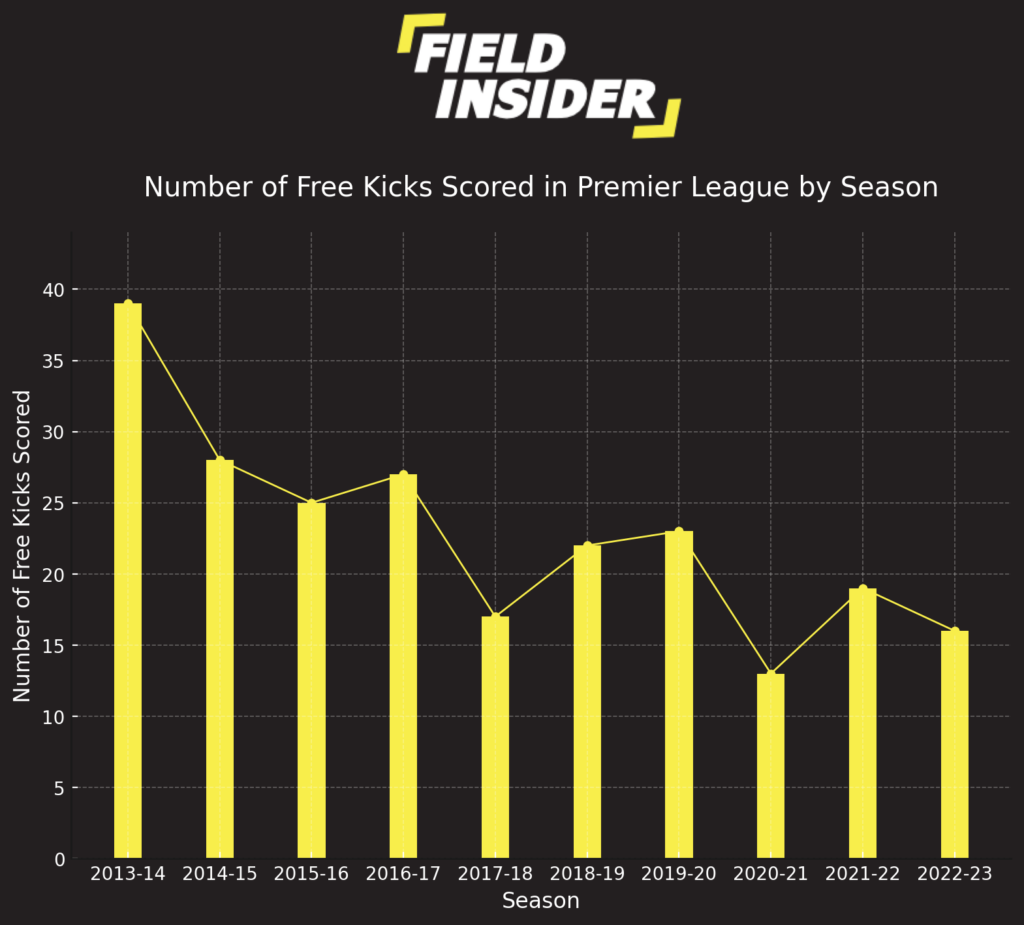
A few things stand out:
| Observation | Detail |
|---|---|
| Peak season | 2013-14 was the high point, with 39 free kicks scored. |
| Downward trend | A clear decline sets in from 2017-18 onwards. |
| Recent low | 2020-21 was the lowest, with just 13. The two seasons after ticked up slightly but stayed low. |
Defensive Tactics Against Free-Kicks
Defending a free-kick is as tactical as taking one. The shape of the wall and where it stands is a small science. Defenders have to anticipate and block or deflect, while the goalkeeper makes the calls that save games.
Forming the Wall
The wall is the key piece. Defenders line up to cut down the angles for the taker. Where it stands depends on the distance from goal and the opponent's kicking style. A well-set wall genuinely cuts the odds of a goal, and I have stood in plenty that did their job.
Goalkeeper's Role
The goalkeeper has to read the ball's path, guessing at power, swerve, or placement. They also organise the wall, making it cover the most vulnerable part of the goal while they cover the rest.
Training and Preparation
Teams put real time into set-piece training, drilling wall formations, goalkeeper work, and simulated free-kicks so it is second nature on matchday. We used to spend the last twenty minutes of a session defending them, over and over, until the whole back line moved as one unit without anyone shouting. When it clicks, the wall jumps together, the keeper knows exactly which post he owns, and a dangerous free-kick becomes a routine clearance.
Notable Free-Kick takers in Football History
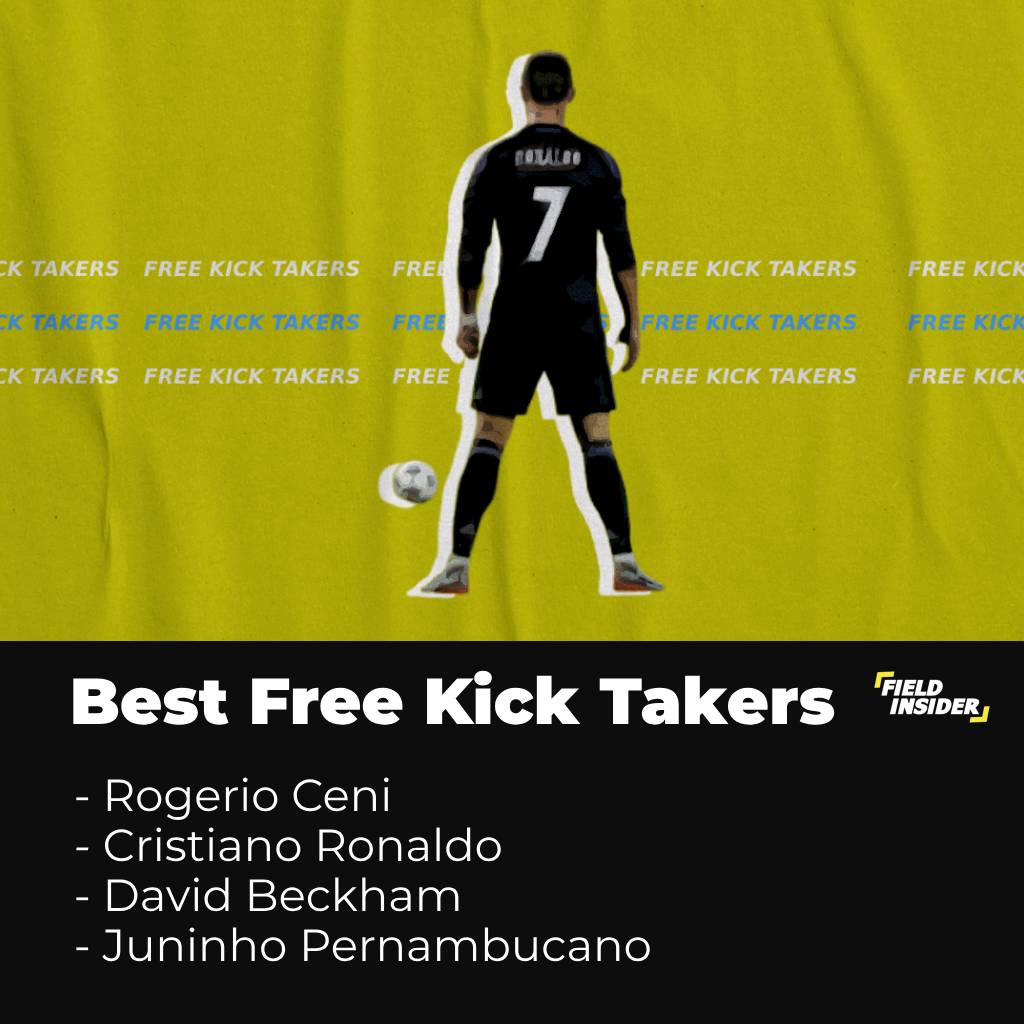
These are some of the most iconic free-kick takers the game has seen, each with their own style.
Top Free-Kick Scorers in Soccer History
| Rank | Player Name | Free Kick Goals | Notable Information |
|---|---|---|---|
| =10 | Rogerio Ceni | 59 | A goalkeeper with an extraordinary scoring record from free-kicks. |
| =10 | Marcelinho Carica | 59 | Renowned in Brazil, played for top clubs like Flamengo and Corinthians. |
| =10 | Ronald Koeman | 59 | Impressive tally for a defender; over a quarter of his career goals from free-kicks. |
| 9 | Cristiano Ronaldo | 61 | One of two active players on this list; potential to rise in ranks |
| =7 | Diego Maradona | 62 | Known for his versatility and skill; a free-kick specialist. |
| =7 | Zico | 62 | Fifth highest goal scorer in Brazil's history; an outstanding career. |
| =5 | Lionel Messi | 65 | Currently fifth; a strong contender for a higher spot in the future. |
| =5 | David Beckham | 65 | The most prolific free-kick scorer from Europe in football history. |
| =3 | Ronaldinho | 66 | Famous for his 2002 World Cup free-kick against England. |
| =3 | Victor Legrottaglie | 66 | Spent entire career in Argentina; never played for the national team. |
| 2 | Pele | 70 | A testament to his all-around skill and ability in the game. |
| 1 | Juninho Pernambucano | 77 | Holds the title of the free-kick GOAT (greatest of all-time). |
Common Misconceptions About Free Kicks
Plenty of myths surround free-kicks. Here are the ones I hear most often.
1. Direct and Indirect Free Kicks Are the Same
Only a direct free kick can be scored straight, without the ball touching another player. An indirect free kick needs a second touch first. That distinction changes how you defend it entirely.
2. The Wall is Just About Numbers
More bodies in the wall does not mean a better wall. Placement, based on the kicker's habits and the goal's weak spots, matters more than the number of players. A well-set wall of fewer players beats a big, badly positioned one.
3. The Goalkeeper's Role is Passive
Keepers do not just hide behind the wall. They read the situation, set their position, and make split-second saves. Their job in that moment is as active as any outfield player's.
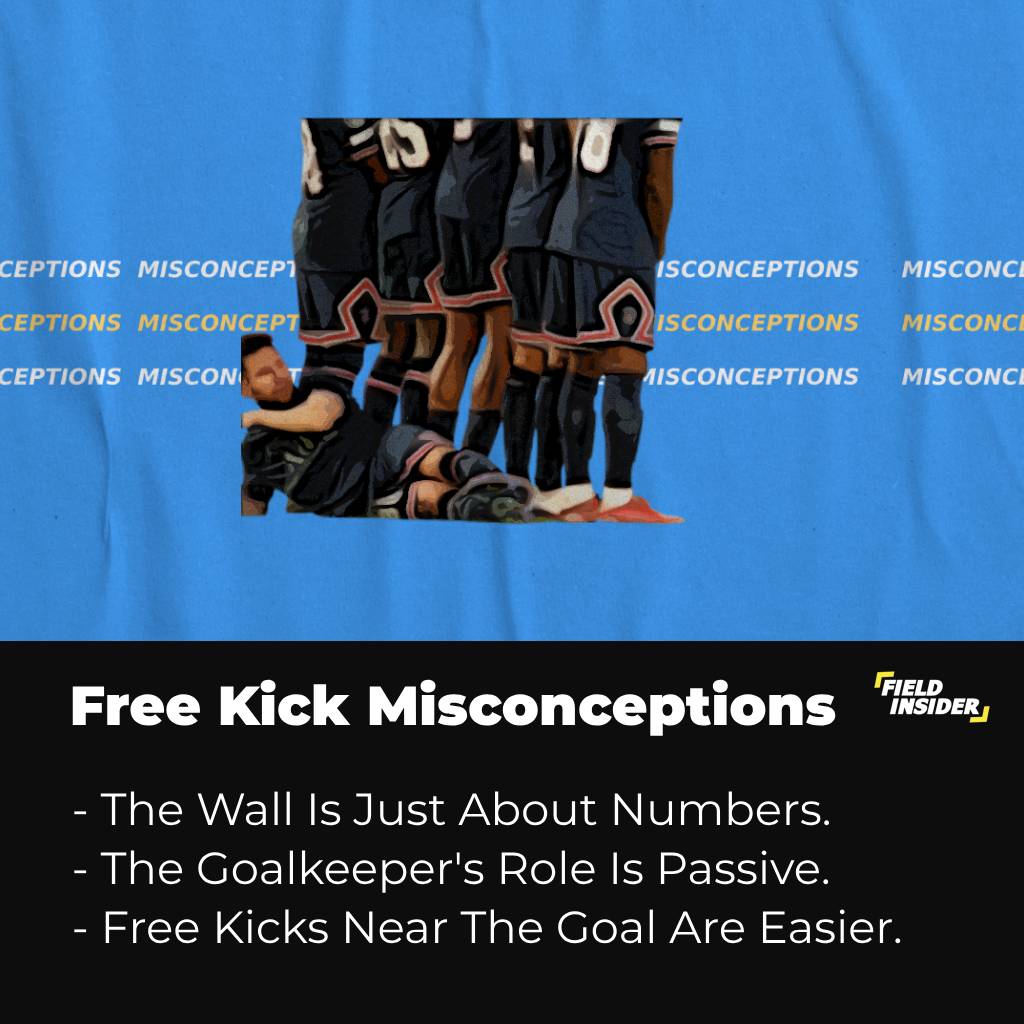
4. Free Kicks Near the Goal Are Easier
Closer looks easier, but it often leaves less room to get the ball over and around the wall. That is exactly where dipping and curving the ball earn their keep.
5. Any Player Can Take a Free Kick
Technically, yes. In practice, it takes a feel for ball physics, real striking technique, and the nerve to handle the pressure. That is why teams have their one or two designated takers and everyone else stands back.
Conclusion
A free-kick is a blend of rules, tactics, and skill. Clear up the myths and you appreciate it for what it is: one of the few set moments in the game where a single strike can decide everything.
Casual fan or lifelong player, once you can read a free-kick, you watch the whole build-up differently.